Reading the Track
One of the most exciting aspects of Supercross and Motocross is the variety of obstacles riders must navigate at high speed. Understanding what these obstacles are and how riders approach them will transform the way you watch a race. Let's break down the most common track features — and how pros manipulate their bikes through each one.
Whoops
Whoops are a series of closely spaced bumps — typically 10 to 15 in a row — that stretch across a section of the track. They're one of the most physically punishing and technically demanding obstacles in the sport. The fastest riders skim across the tops of the whoops at incredible speed, while a small mistake can send a rider into a violent bucking motion that's nearly impossible to recover from. Whoops separate the elite from the rest of the field.
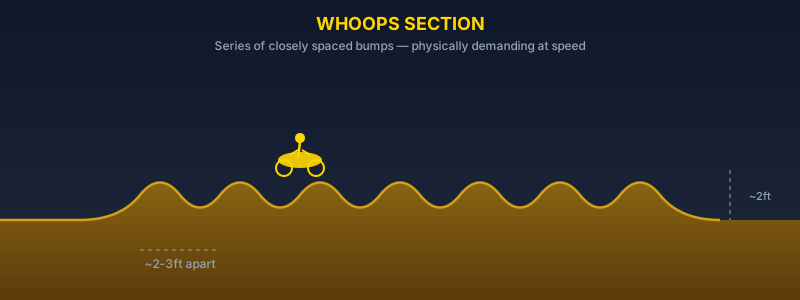
How Riders Attack Whoops
- Body position: Stand up on the pegs, weight shifted slightly rearward, elbows high and wide. Legs act as shock absorbers.
- Blitzing (fast line): Elite riders pin the throttle and skim across the tops at 30+ mph, barely touching each peak. The bike skips like a stone — this requires incredible core strength and arm endurance.
- Jumping through: Slower riders may jump into the whoops and let the bike bounce through, but this is slower and more fatiguing.
- Throttle control: Constant, steady throttle is critical. Chopping the gas mid-whoops causes the rear end to kick sideways — a recipe for a crash.
- The scrub: Some riders pre-load their suspension before the whoops entry to set the bike's pitch angle for skimming.
Rhythm Sections
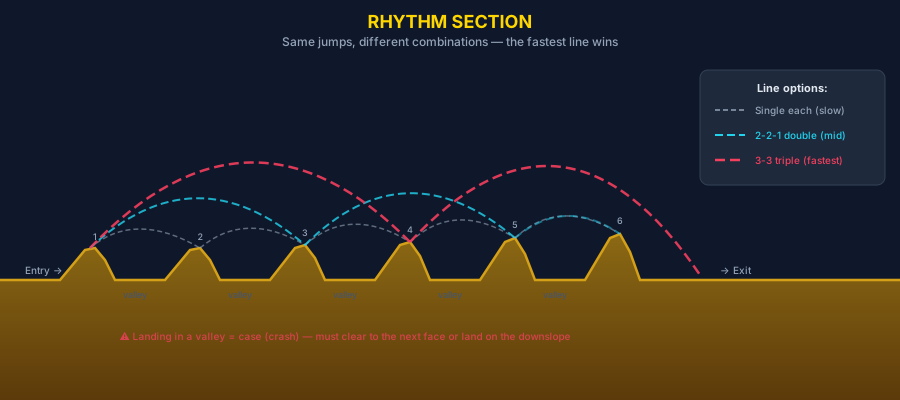
Rhythm sections are the strategic heart of a Supercross track. They consist of a series of jump faces (takeoff ramps) separated by valleys. The key is that riders can combine these jumps in different ways to find the fastest line:
- Singling: Jumping one face at a time — safe but slow
- Doubling: Clearing two jump faces in one leap — the standard intermediate line
- Tripling: Launching over three jump faces at once — the pro line that saves major time
- Quad: The most daring option — clearing four faces. Only attempted by the fastest riders on specific layouts.
Finding the fastest rhythm through these sections is where races are won and lost. A rider who can triple through a section while others are doubling gains significant time on every lap.
How Riders Manipulate the Bike in Rhythms
- Pre-loading the face: Riders compress their suspension just before the takeoff lip by pushing down through their legs, then exploding upward. This loads the fork and shock to launch the bike higher and farther.
- Seat-bouncing: For bigger jumps (triples, quads), riders sit down and bounce off the seat on the takeoff face to gain extra height. The timing is everything — too early and you come up short.
- Scrubbing: To stay LOW over smaller jumps (and save time), riders whip the bike sideways off the lip, keeping the wheels closer to the ground. This technique was popularized by James Stewart and is now essential at the pro level.
- Case prevention: Landing in a valley between jump faces (called "casing") is extremely dangerous. Riders must judge their speed precisely — too slow means casing, too fast means overshooting into the next face.
- Mid-air adjustment: Riders use throttle (rear wheel spin) and brake (stops rear wheel) to adjust pitch in the air. Tapping the rear brake drops the front end; blipping throttle raises it.
Tabletops and Step-Ups
A tabletop is a jump with a flat top — the takeoff and landing are connected by a plateau of dirt. They're relatively forgiving because a rider who comes up short will land on the flat top rather than in a gap.
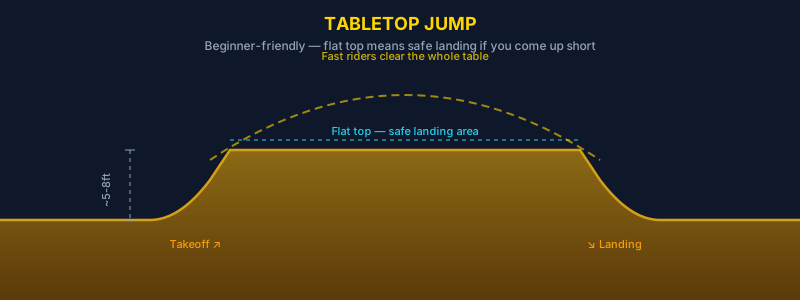
How Riders Handle Tabletops
- Speed judgment: Fast riders clear the entire tabletop, landing on the downslope for maximum speed. This is significantly faster than landing on top.
- Scrubbing: On tabletops where clearing is easy, pros will scrub the lip to stay low and shave fractions of a second. The bike barely leaves the ground.
- Body neutral: Centered body position with slight forward lean on takeoff. Arms and legs absorb the landing with knees gripping the bike.
- Downslope landing: The goal is to match the bike's angle to the landing ramp, absorbing impact through bent knees and elbows.
A step-up is a jump where the landing is significantly higher than the takeoff, requiring the rider to carry extra speed and height. The opposite, a step-down, has a lower landing that riders drop into.
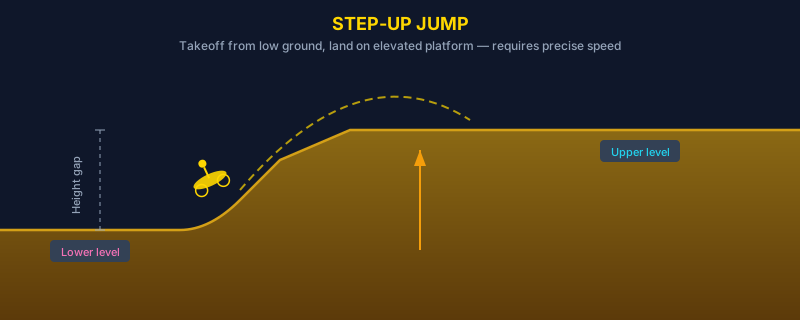
How Riders Handle Step-Ups and Step-Downs
- Step-ups require commitment: Riders must carry extra speed because they're fighting gravity — the landing is above them. Coming up short on a step-up means slamming into the face of the upper level. Hesitation is punished severely.
- Body forward on takeoff: Weight shifts forward to keep the front end from rising too high. The bike needs to arc upward and land flat on the elevated platform.
- Step-downs are deceptive: The landing is lower, so riders have more airtime than expected. They must push the front end down (tap rear brake in the air) to avoid nose-diving on landing.
- Absorb with legs: Both obstacles demand active leg suspension — the rider's body acts as a secondary shock absorber.
Sand Sections
Sand sections slow the pace dramatically and test a rider's technique. The soft, shifting surface saps energy from both rider and machine, requiring a specific throttle control style and body position. Some tracks, like Daytona's Supercross course, are famous for their deep sand sections.
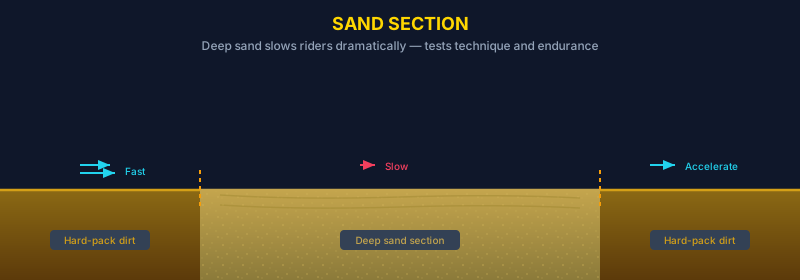
How Riders Navigate Sand
- Stand up, weight back: The most critical adjustment. Riders stand tall on the pegs and shift their weight rearward to keep the front wheel light. A buried front wheel in sand means an instant endo (front-flip crash).
- Smooth throttle: No sudden acceleration or deceleration. The rear tire needs to paddle through the sand with consistent power. Aggressive throttle causes the rear to spin out; chopping it causes the bike to dig in and stop.
- Paddle tires (outdoor MX): In outdoor Motocross, some teams run paddle-style rear tires for sandy tracks like Southwick. The paddle scoops sand for better traction.
- Line selection: In sand, the ruts get deep fast. Riders must commit to a rut or find a clean line on the edge — switching mid-section usually means losing the front end.
- Physical endurance: Sand sections are exhausting. The vibration and constant correction tax the forearms (arm pump), making late-race passes in sand sections common when fatigued riders make mistakes.
Berms and Turns
Berms are banked turns built up with packed dirt, allowing riders to carry speed through corners. A well-built berm lets riders rail through a turn at full speed, while flat turns with no berm require hard braking and precise throttle control. Most tracks feature a mix of both, with tight 180-degree berms being a staple of Supercross design.
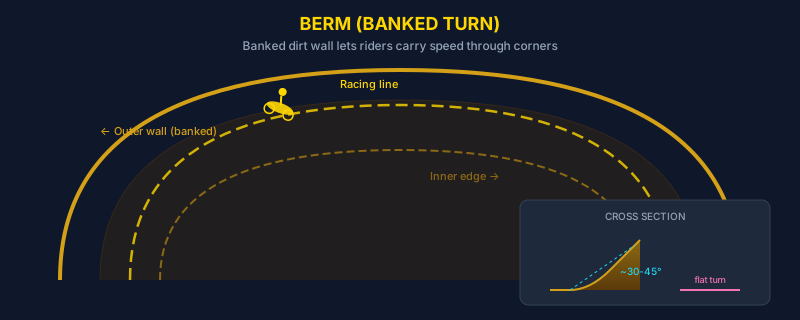
How Riders Rail Berms and Flat Turns
- Berms — weight the outside peg: The rider pushes hard on the outside footpeg (right peg in a left turn) and leans the bike underneath them. This drives the tires into the berm for maximum traction.
- Look through the turn: Riders look where they want to go, not at the ground in front of them. Head and eyes point to the exit of the turn.
- Throttle out of the apex: The fastest riders get on the gas before the apex of the turn, using the berm wall to hold them as they accelerate out.
- Flat turns — rear brake slide: Without a berm, riders use the rear brake to slide the back end around, pivoting on the front wheel. This requires backing into the turn with a controlled slide.
- Rut riding: As berms break down during a race, ruts form. Riders must drop their inside peg into the rut and let the bike follow the groove — fighting a rut usually means crashing.
- Body position shift: In a berm, the rider's inside knee may come off the bike and point into the turn (similar to road racing), helping shift the center of gravity.
Dragon's Back
A dragon's back is a long, pointed ridge of dirt that riders must navigate carefully. It resembles the spiny back of a dragon, with a sharp peak that can upset a bike's balance if not approached correctly.
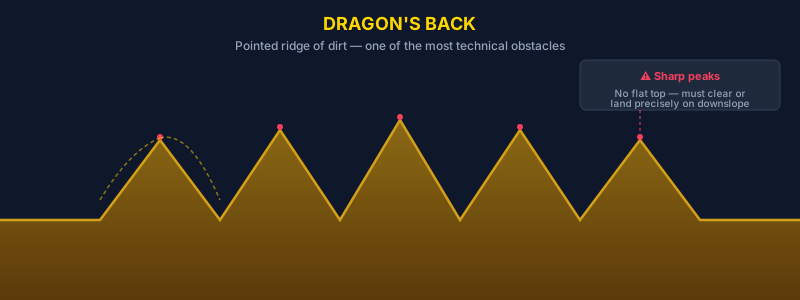
How Riders Attack a Dragon's Back
- Precision speed: Too fast and the bike launches off the peaks uncontrollably. Too slow and the rider gets stuck on a peak with no momentum. The sweet spot is narrow.
- Active body position: Riders stay standing with knees bent, constantly adjusting weight forward and backward as the bike goes over each peak. The body essentially counter-moves the bike's pitch.
- Clutch and throttle feathering: Small, precise inputs keep the rear wheel hooked up on the backside of each ridge without spinning out. The clutch is used almost as much as the throttle.
- Line choice: Some riders skip along the top; others try to find a line slightly off-center where the peaks are less sharp. The ideal line often changes as the track deteriorates during the race.
The Start Straight
Every race begins with the start straight — a long, flat section where up to 22 riders launch side by side when the gate drops. Reaching the first turn with the lead — known as the holeshot — is a massive advantage, making starts one of the most critical moments of any race.
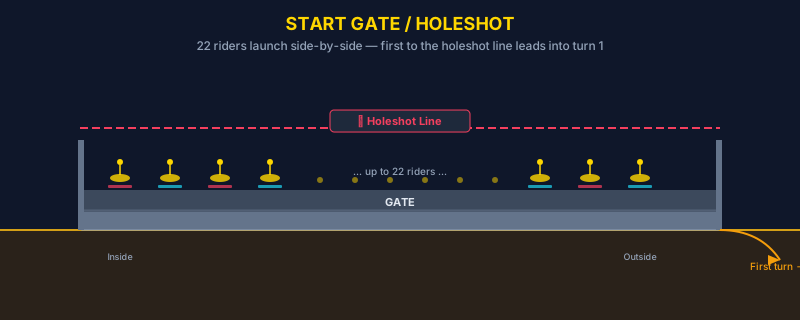
How Riders Launch from the Gate
- Gate pick strategy: Riders pick their gate position based on qualifying. Inside gates have a shorter distance to the first turn but get pinched by the pack. Outside gates have more room but a longer path.
- The launch: Rider leans over the front of the bike, clutch in, throttle held at a precise RPM. When the gate drops, they dump the clutch and shift their weight forward to prevent a wheelie.
- Wheelie control: The biggest challenge is keeping the front wheel down. Too much power and the bike loops out backward. Many riders use a technique called "clutch fanning" — rapidly engaging and disengaging the clutch to modulate power.
- First turn chaos: The holeshot line marks the official first-to-the-turn leader, but the real battle is surviving turn one with 22 bikes converging into a space meant for 3-4. Crashes here are common and can end a rider's entire race.
- Rev limiter strategy: Some riders hold the throttle against the rev limiter so they can focus entirely on the clutch. Others modulate both simultaneously for a smoother launch.